

Students and faculty team up to help local community adapt to climate change
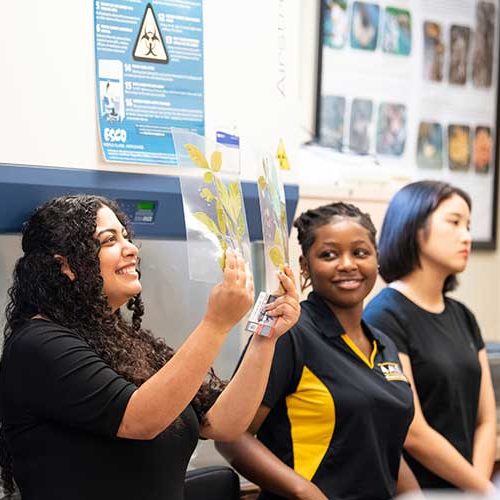
As Northeast Ohioans along with people around the world live through unprecedented levels of natural disasters due to climate change, students and faculty at The College of Wooster are helping community members adapt to the changing environment. Meagen Pollock, professor of earth science and Gregory Wiles, Schoolroy Chair of Natural Resources and professor of earth sciences, partnered with students Chamari Abercrombie ’24, Elizabeth Braun ’24, Ellen Yoon ’24, Kai Leisher ’24, Luke Wilson ’24, Grace Hodges ’23, Mazvita Chikomo ’22, and Layali Banna ’22, in a community water project to establish a data collection and monitoring system to help deal with excess stormwater runoff. The eight-week project is one of twelve Applied Methods and Research Experience or Wooster AMRE projects this summer, as students team with faculty advisor(s), local businesses, and organizations, to apply their education to real-world problems, in this case, climate change.
Because climate change is a complex and global phenomenon, Pollock and Wiles work with their students to understand its local impact. “One of climate change’s big effects in this area is that we’re getting a lot more rain and bigger storms,” said Pollock, “which is measurable in our area and affects people’s lives through flooding.”
The team produced multiple solutions to adapt to these challenges, primarily a Non-Point Source Implementation Strategy (NPS-IS) for the watershed of Apple Creek, a frequently flooded waterway south of downtown Wooster, and research on tree ecosystems services. The NPS-IS is a watershed-based plan that allows communities to pursue EPA funding to reduce pollution along local waterways. “We started the NPS-IS with the hope that future members of the team will finish it,” said Wilson, a mathematics and physics major. “If finished and submitted, this report would not only save Wooster money, but would also make the city eligible for funding to control flooding.” The project also provides Northeast Ohio with up-to-date research on tree ecosystems. Local partners will use this research to understand how trees impact precipitation rates and what trees thrive in the area. “We help our partners by providing information about the area trees grow in, and how well those trees respond to precipitation rates,” said Pollock.
As the Community Water Project improved the local community’s response to climate change, the AMRE project also provided students with hands-on professional experience. In the morning, students met at Scovel Hall to discuss and plan daily objectives, then worked individually and collaboratively on these tasks throughout the day. “I was often tasked with creating maps for our reports,” said Wilson, “so I spent a lot of time by myself in the computer lab, communicating with my teammates.” After work, the students spent the evening bonding over fun activities and reflecting on the day’s accomplishments and objectives. Pollock and Wiles provided mentorship to students in the initial stages of the summer experience, but students led the project’s day-to-day activities, tasks, and objectives.
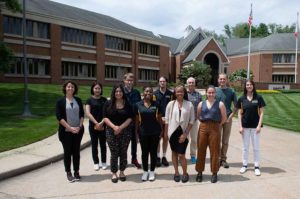
The team visited Davey Tree Institute. Pictured here are back row: Ellen Yoon, Kai Leisher, Nick Wiesenberg (ESCI Technician), Greg Wiles, Luke Wilson, Elizabeth Braun; front row: Meagen Pollock, Layali Banna, Mazvita Chikomo, Chamari Abercrombie, and Grace Hodges.
While collaborating with the College’s faculty and fellow students, partnerships and collaborations in the broader Wooster community provided students the opportunity to apply their coursework in the field. “This is an opportunity for our students to get to know potential employers, internship locations, and to gain relevant experience,” said Pollock. Partnerships with nearby organizations, such as Trout Unlimited: Clear Fork River Chapter, allowed students to travel and conduct research in the field. “In this program we got involved with the Wooster community by conducting research and visiting sites, such as Apple Creek, with Trout Unlimited” said Abercrombie, an undecided major, “we observed the presence of macro-invertebrates in the stream and placed transducers in the stream to analyze the relative health of the stream.” Students also collaborated with The Davey Tree Expert Company. “Davey Tree helped us look at how different engineering options impact water’s interaction with Wooster’s physical infrastructure,” said Hodges, a biology and political science major, “on Davey Tree’s campus, we attended talks focused on trees’ impact in civil communities and their intentional placement in Wooster. Hodges finds that these partnerships manifest her love for Wooster into positive community action. “I was interested in being able to see my work reflect directly into the Wooster community, a place I call home, so it was really cool to see my research put into action here.”
Throughout their work on the project this summer, students also learned a multitude of technical and nontechnical skills. “Some of the technical skills that students gained during this experience are in geographic information system mapping, software programming, and field techniques such as coring trees, analyzing tree rings, dendrochronology, along with measuring stream profiles and soil depth,” said Pollock. Along with technical skills, students learned non-technical skills for future professional experiences, such as communication, writing, and leadership skills. “I learned a huge swath of technical skills,” said Hodges, “but I also picked up a huge number of professional skills through this project, such as building a network and advising fellow students in the project,” said Hodges. Collaborating on the project also allowed students from different majors to reflect on their interests and how to apply what they learn in their next steps at Wooster. Abercrombie, who had no previous experience in climate science, found new interest through the experience, “I wanted to explore nature while finding ways to improve natural habitats in the Wooster community,” she said. “I gained long-lasting relationships with my peers, mentors, and advisors.”
Image 1 above: Luke Wilson, Layali Banna, Mazvita Chikomo, and Ellen Yoon during a site visit to Davey Tree Institute.
Posted in Experiential Learning, Faculty on August 13, 2021.
Related Posts

Related Areas of Study
Physics
With one-on-one guidance from a faculty mentor, every physics major completes independent research in a year-long research project
Major MinorMathematics
Numbers + patterns + structures multiplied by a zest for analysis and inquiry
Major MinorEnvironmental Studies
Natural sciences, social sciences, and humanities courses combine for those who want to be part of environmental solutions
Major MinorEarth Sciences
Geology, environmental geoscience, geophysics, and other classes that explore Earth and the impact of humans
Major MinorEnvironmental Geoscience
Investigate the impact humans have on the Earth and research ways to solve pressing environmental problems.
Major Minor