Studio art and philosophy alumna explores loss and memory through painting
Growing up in a small town in China, Xiangjie Rebecca Wu ’22 had always hoped to attend college in the United States. As an international student at […]

The study of philosophy has proven to be useful in many ways, from the formation of health care policies to the development of computer languages. It can be the foundation for graduate study in almost any field. Philosophy majors at The College of Wooster have gone on to successful careers in law, business, computer programming, teaching, social work, ministry, journalism, publishing, the arts, public advocacy, and medicine. Because of the multidisciplinary nature of Wooster’s liberal arts approach, philosophy majors often find they can double major in almost any other discipline and still graduate in four years.
Philosophy is practiced best within a friendly community where discussions and interactions extend beyond the classroom. One of the long-standing traditions of our program is the Philosophy Roundtable. Students and faculty meet weekly to discuss questions of current concern or recent philosophical research. In these lively and collegial sessions, students can explore ideas informally and engage with invited speakers. Indeed, the small-college atmosphere of Wooster provides students with many opportunities to engage directly with visiting scholars, with the faculty, and with their peers. We regard this as essential to the intellectual development of our students.
Many of our students pursue a double major with another department, fostering vibrant interdisciplinary learning. We have had double majors with departments as diverse as art, biology, communications, economics, English, German studies, history, mathematics, physics, political science, psychology, and religious studies. Similar breadth is reflected in our curriculum. In addition to courses that are central to the discipline, such as Ethical Theory, we also regularly offer courses on such topics as philosophy of education, the law, biomedical ethics, environmental ethics, and race, gender, and justice. Additionally, we offer courses in non-Western traditions, including World Comparative philosophy, Chinese philosophy, and Indian philosophy. A number of our majors also study overseas for a semester, often at programs in England, Germany, Greece, New Zealand, or Scotland.
Wooster’s Philosophy Courses
Visiting Assistant Professor of Philosophy; Co-Liaison to the Public Health Pathway
Frank Halliday Ferris Chair of Philosophy; Department Chair of Philosophy

Administrative Coordinator - Earth Sciences, Philosophy, Environmental Geosciences, Geology


Professor of Philosophy; Chair of South Asian Studies; Classical Studies

Elias Compton Professor of Philosophy; Middle Eastern & North African Studies
Growing up in a small town in China, Xiangjie Rebecca Wu ’22 had always hoped to attend college in the United States. As an international student at […]
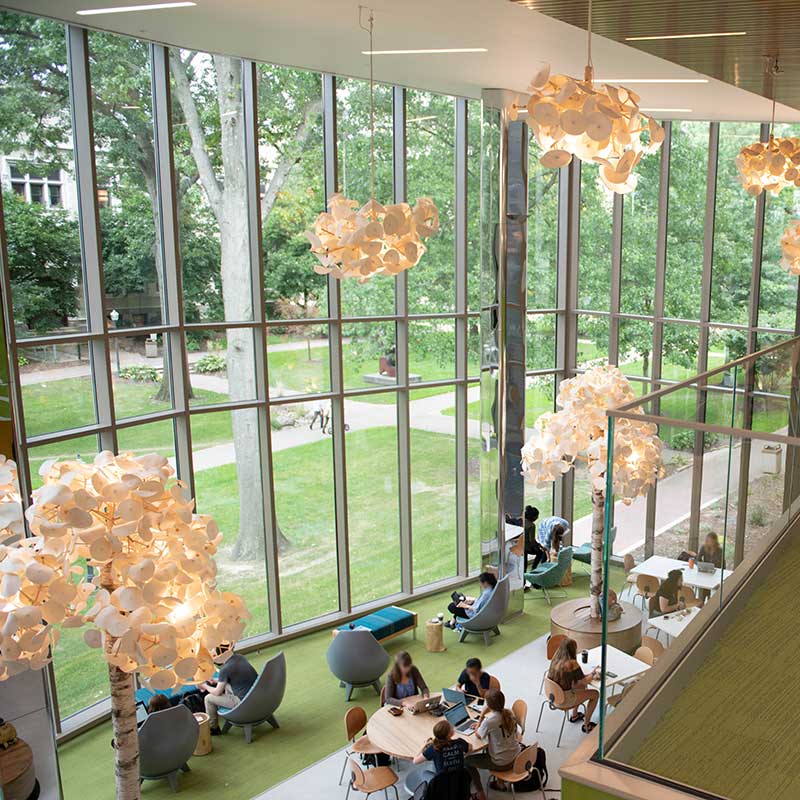
The College of Wooster will welcome three speakers for a series of lectures and dialogues titled Democracy and Academic Freedom, A Forum. Speakers will […]

Désirée Weber, professor of political science at The College of Wooster, contributed a chapter to the edited volume Wittgenstein and Democratic Politics: Language, Dialogue […]
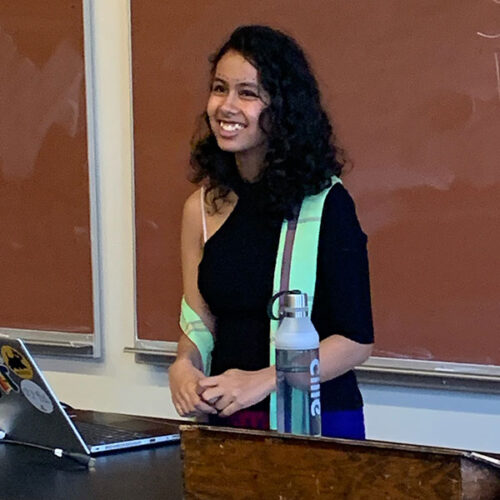
Recent College of Wooster graduate in history and philosophy, Aaron Huq ’24 received the Quantedge-Cambridge Refugee Masters Scholarship to pursue a Master of Philosophy […]
The Philosophy Department has as its fundamental mission the cultivation of skills, dispositions, and knowledge in its students contributing to their development as autonomous persons and as responsible and engaged members of society. These skills and dispositions are acquired and honed through studying and doing philosophy. They facilitate a student’s development by enabling the critical, systematic, and philosophically informed examination of beliefs, values, and conceptions of the world. Such an individual has an independent mind: one that is open, flexible, creative, critical, and capable of making well-reasoned decisions.
A major in philosophy consists of courses that include logic, ethical theory, and the ancient philosophies of Aristotle and Plato.
Philosophy Major Handbook View CoursesMany students have found a minor in philosophy to be a valuable supplement to other majors in the natural and social sciences and other humanities departments. Students are strongly encouraged to take Philosophy 100: Ethics, Justice, and Society as a first course in philosophy. Six courses in philosophy are required to earn a minor.
View CoursesWe regard the three semesters of Independent Study (I.S.) as a vital component of the intellectual growth of our students.
In the senior research project, students choose their own topic of investigation, design and write a thesis, research important current work in the area, and argue clearly for their own view. While these projects are pursued under the guidance of a faculty adviser, we encourage our students to follow their own interests, and this results in a wide range of theses topics. Recent Philosophy I.S. projects include the following:
The I.S. process enables our students to deeply develop their analytic, argumentative, research, and organizational skills in their authoring of this sustained philosophical research project.
| Student | Year | I.S. Title | Major 1 | Major 2 | Advisor |
|---|---|---|---|---|---|
| Please search to view results | |||||

With a growing interest in bioethics, Naomi Mann ’24 designed a senior Independent Study to investigate the ethical principles and processes involved in medical […]

Alix Printup ’23 cares deeply about his Indigenous community—the Seneca Nation, the largest of six Native American nations which comprised the democratic government of […]
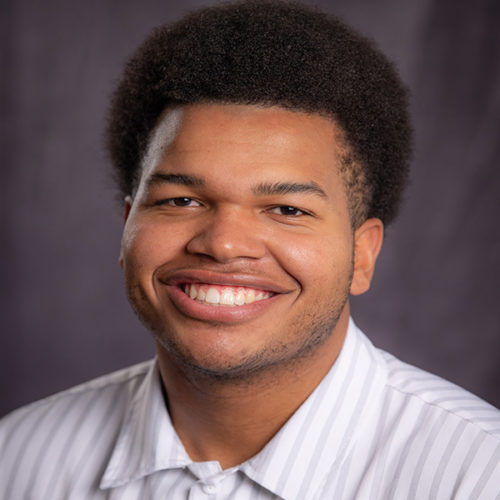
Name: Langston Hood Majors: English, Philosophy Advisors: Allison Cardon, Elizabeth Schiltz This Independent Study thesis consists of six chapters. The first chapter, titled “Determinism”, […]

Name: Kevin Poe Major: Religious Studies, Philosophy Minor: South Asian Studies Advisors: Mark Graham, Elizabeth Schiltz In December of 2022 I traveled to Bodh […]
The study of philosophy can be the foundation for graduate study or professional aspiration in almost any field. Philosophy majors at Wooster have gone on to successful careers in law, business, computer programming, teaching, social work, ministry, journalism, publishing, the arts, public advocacy, and medicine, among other pursuits.
Recent philosophy majors have gone on to study philosophy in graduate school at such places as Brandeis University, Cambridge University, Duke University, Georgetown University, London School of Economics, Princeton University, Tufts University, University of California-Santa Cruz, University of Iowa, University of North Carolina-Chapel Hill, University of Notre Dame, University of Oklahoma, University of Pittsburgh, University of Tennessee, University of Toronto, Virginia Tech University, Western Michigan University, and the University of Wisconsin.
The Lindner Endowment was established in 2007 by Carl H. Lindner of Cincinnati, Ohio, to benefit the Department of Philosophy. The purpose of the Lindner Lectureship is to support the teaching of ethics.
The Hustwit Prize, which was established in 2007 by students, colleagues, and friends of Ron Hustwit, will be awarded annually to a senior philosophy major who, in the judgment of the Department, has shown great love of both the subject and the practice of philosophy. This prize honors Professor Ronald Hustwit for his life-long commitment to the students at the College of Wooster and for his contributions to the cultivation of philosophical skills, dispositions, and enthusiasm for philosophy among those students. Recipients of the Hustwit Prize have been:
The Miller Prize, established in 1913, is given at graduation to the major student who has the highest standing in Philosophy. Recipients of the Miller Prize have been:
The Remy Johnston Prize was established in 1989 by the Johnston family and the faculty and students of the Department of Philosophy in memory of Remy Alexander Johnston, a senior Philosophy major at the College. The prize is awarded annually to a senior Philosophy major who, in the Department’s judgment, has shown outstanding progress in developing philosophical skills and promise as a philosopher. Recipients of the Johnston Prize have been:
The Kreuzman Philosophy Roundtable Prize was established by the Department of Philosophy to honor Professor Hank Kreuzman’s lifelong commitment to the practice of philosophy in the context of a liberal education. This commitment was manifested in his long teaching career at the College, his dedicated stewardship of the department, and his reliable posing of penetrating questions and insightful comments at Philosophy Roundtable discussions. The prize is endowed in 2024 by Henry B. Kreuzman, Professor Emeritus of Philosophy, and Mary Joan Kreuzman, former Visiting Assistant Professor of Mathematics. Income from the fund is awarded annually to a student or students in philosophy who have contributed significantly to the Philosophy Roundtable.