Poster Session Illuminates Value of Lessons Learned through Summer Research
11 students share their projects following 10-week Research Experience for Undergraduates program
Contact
John Finn
330-263-2145
Email
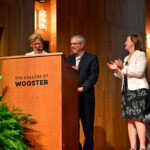
WOOSTER, Ohio - In looking back over the past 10 weeks, Margaret Raabe can't believe how much she has learned. Neither can Amanda Logue. The two College of Wooster students were among 11 participants in the annual Research Experience for Undergraduates (REU) summer program funded by the National Science Foundation, which concluded Friday with a poster session in Taylor Hall.
"This was such a good experience," said Raabe, a rising sophomore from Bexley, Ohio, who looked at solar escape as a special case of the three-body problem. "I learned so many new things, like how to write computer programs. You can't get this type of opportunity in the classroom."
That's precisely the point, according to Susan Lehman, assistant professor of physics and a major proponent of summer research. "Students acquire many different skills in this setting, which helps them to become practicing scientists," she said. "They learn to ask the right questions and then communicate what they have learned through presentations and poster sessions like this one."
Logue, a rising junior from Jacobsburg, Ohio, conducted research on a variation of the two-body problem, and she, too, was impressed by the steep learning curve. "I was forced to learn computational methods, which I wasn't crazy about at first, but now I'm glad I did it," said Logue, who is double majoring in physics and chemistry.
Both students acknowledged the vital role of the advisor, which in their cases was John Lindner, professor of physics at Wooster. "He was amazing," said Logue. "You want an advisor who is always there when you need him, and he was." Raabe, who is planning to declare physics as her major this fall, agreed, saying, "Dr. Lindner taught me a lot, especially about programming."
Logue and Raabe believe that their summer research experience will give them an edge when competing with students who have not had the same opportunity. "I feel like I have an advantage now," said Raabe, who is eying a possible career in aeronautical engineering. "This experience will help me when I am ready to apply for another research opportunity."
In addition to Logue and Raabe, six other students from Wooster and one each from Bucknell, Kenyon, and Ohio Northern participated in this summer's REU. From Wooster, rising sophomore Katsuo Maxted studied one-way coupling in two and three dimensions with Lindner, and recent graduate Henry Timmers looked at cavity ring-down spectroscopy with Lehman. Also from Wooster, rising sophomores David Simpson (heat capacity for the system comprising a triblock copolymer in water) and Larry Markley (self-organized criticality), and rising seniors Heather Moore (granular percolation) and Alison Huff (analysis of spherical micelles using refractive indices and dynamic light scattering) worked with Professor of Physics Don Jacobs. The other three students were Erin Ford of Kenyon, who studied the Mpemba effect (whether hot water freezes faster than cold water) with Lehman; Conrad Moore of Bucknell, who looked at designing and visualizing exotic space times with Lindner, and Mitchell Thayer of Ohio Northern, who explored pH effects on the properties of UV-absorbers with Sarah Schmidtke, assistant professor of chemistry at Wooster.
Last week's poster session provided a fitting conclusion to the 10-week session and offered a few parting lessons for the students: (1) the importance of being able to communicate one's research to a general audience, and (2) the realization that focused summer research programs provide invaluable experience for aspiring young scientists.