AMRE Reinforces Value of Critical-Thinking and Problem-Solving Skills
Students discuss their summer research at annual Projects Day Presentation
Contact
John Finn
330-263-2145
Email
WOOSTER, Ohio - Of all the lessons learned by students in The College of Wooster's Applied Mathematics Research Experience (AMRE) this past summer, one stood out above the rest: highly developed critical-thinking and problem-solving skills are vital in today's workplace.
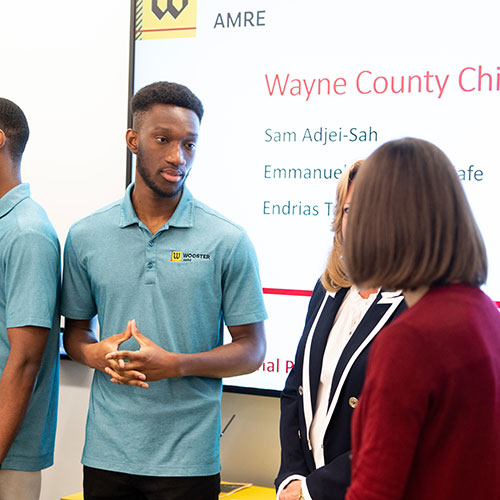
Seventeen students took part in the annual eight-week session, during which they served as paid consultants to clients in business, industry, education, government, and the non-profit sector. The students were grouped into five teams of three and one team of two. Each was then assigned at least one faculty adviser. Their objective was to come up with solutions to a range of real-world challenges and problems, which they shared at the 16th annual AMRE Projects Day on Nov. 19 in
Lean Lecture Room of Wishart Hall.
Most of the projects were contracted with existing clients, who were pleased by results from previous years. The first group, which consisted of Daniel Norris, Itai Njanji, and Evan Radkoff, was called on to enhance and maintain software tools from Prentke Romich Corporation, a nearby manufacturer of assisted communication devices. The three students, who were advised by Denise Byrnes (associate professor of computer science at Wooster), successfully eliminated bugs in the Performance Report Tool (PeRT) and the Performance Report Library (PeRL), which provide resource data for speech therapists. The group also overhauled the algorithm so that therapists could search the data more efficiently.
The second team, made up of Robert Taylor, Josh Thomas, and Trisha Fultz, worked with Wooster's Dean of Students Office to upgrade its content management system. The students, who were also advised by Byrnes, adjusted user access levels, created new security groups, and refined the current system (known as Panosophy), which enables the office to track such issues as academic
performance, social behavior, and health history. Although the group experienced a few "technical snafus," according to Thomas, they were able to upgrade the system, and may look into marketing it to other schools in the future.
Bilal Paracha, Will Daniel, and Jiuwei Zhang, along with Jim Burnell (professor of economics), comprised the third group, which worked with FirstEnergy Corp on the development of a model to predict consumer behavior when shopping for utilities. Paracha, who was the group's only spokesperson because Daniel and Zhang were studying off campus, explained how he and his fellow students first had to learn about the company and the impact of deregulation on the industry
before beginning work on the project. "We had to develop a theory first," he said. The group came up with several methods to predict demand based on comparative prices and competitive markets.
The fourth team, which consisted of Nancy Tinoza and Hannah Roberts, tackled a pure math problem with funding from the Howard Hughes Medical Institute (HHMI). John Ramsay (professor of mathematics) and Pam Pierce (professor of mathematics) served as advisors for the project, which picked up on the continued investigation of Tarski's circle-squaring problem. Specifically, Roberts and Tinoza worked on an algorithm for polygon dissection - the process of cutting a polygon into a finite number of pieces and reforming them into a square.
The fifth group, also advised by Ramsay and Pierce, consisted of Gabe Avila, Yang Tian, and Kevin Nicholson, who were charged with analyzing the metrics that measure the competitiveness of Progressive Insurance in the marketplace.
The sixth team, made up of Prachi Saraogi, Shiladitya Roychoudhuri, and Jeff Lyman, and advised by Jennifer Roche (assistant professor of mathematics), worked with several internal groups: the alumni office, the admissions office, and AMRE itself. The alumni project involved the development of a tool that would aid the office in identifying the most active and inactive former students. The
admissions project sought to estimate the probability of student prospects from different groups applying, being accepted, and ultimately enrolling at Wooster. The third project involved an analysis of various Internet networking systems in an effort to determine which would best serve the needs of AMRE and Wooster's Social Entrepreneurship program.
"Once again this year, we witnessed the value of being able to conduct research in the areas of mathematics and computer science," said Ramsay. "There is a very real need for these services, and our students are able to apply their critical-thinking skills while solving problems for our clients."