

NSF Awards $525,000 Grant to Wooster’s Chemistry Department
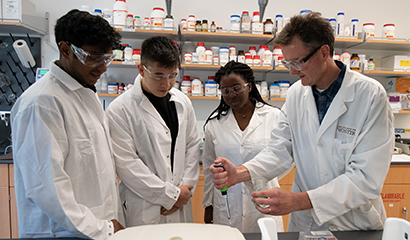
WOOSTER, Ohio – The National Science Foundation has awarded The College of Wooster and the State University of New York at Cortland a collaborative three-year grant, and a substantial one at that totaling $525,000, to further research on how soil-dwelling bacteria can break down small molecule pollutants, specifically N-heterocyclic aromatic compounds (NHACs). Mark Snider, the Robert E. Wilson Professor of Chemistry at Wooster, will serve as the principal investigator.
NHACs are commonly found in personal care and pharmaceutical products, as well as herbicides and pesticides, and they wind up in soil and water as pervasive environmental pollutants. Depending on the substance, these molecules can pose significant health risks to those who inadvertently consume them and are toxic to the animals that have chronic exposure.
Snider, his undergraduate researchers, and the team at SUNY Cortland, led by assistant chemistry professor Katherine Hicks, will work together “to determine the biochemical mechanisms that these bacterial enzymes use to degrade nicotinic acid (a model NHAC),” according to the grant proposal. In simpler terms, they hope to discover how the harmless soil-dwelling bacteria can remove the unwanted NHACs in the environment, then use that knowledge to potentially enhance decontamination efforts.
By using genetic engineering and structural protein X-ray crystallography, this research will identify the function and molecular mechanisms of the enzymes that are involved in the pathway for breaking down nicotinic acid. “We have already determined the structure and proposed a chemical mechanism for two of the seven enzymes in this degradation pathway. This new grant will provide the resources for us to determine the other mechanisms and also identify novel pathways of enzymes that soil bacteria have evolved to degrade these contaminants,” explained Snider.
The concept of common bacteria consuming and breaking down harmful elements from the environment is called bioremediation, which is an important, and flourishing, area of research. Thus, this NSF-funded project will give Wooster and SUNY Cortland students a leg up on their budding careers, according to Snider. “This work will provide undergraduate students with training in modern biochemical techniques, skills necessary to answer complex questions about environmental contamination, and preparation for STEM field careers,” he said.
The NSF grant, of which Wooster’s share is $260,740, will enable two Wooster students to engage in undergraduate research during each academic year, plus three to take part in a 10-week summer research program, and when the research is complete, students will travel and present their findings at scholarly meetings. Additionally, the SUNY Cortland student researchers will join their Wooster counterparts and serve as mentors at the renowned Buckeye Women in Science, Engineering, and Research Institute (B-WISER), a week-long summer camp for middle school girls interested in science.
“Thanks to the support of the NSF, we will be able to pursue this project using more sophisticated tools that will enhance our understanding and help us translate that new knowledge to applications more quickly,” added Snider, now in his 18th year as a professor at Wooster. “The grant also provides more intense research experiences for our undergraduate science majors and will enable us to develop a week-long research project for younger scientists in the B-WISER program. One of the most enjoyable aspects of my career is collaborating with Wooster students and faculty in research.”
Posted in Faculty, News on September 27, 2018.
Related Posts

Related Areas of Study
Chemistry
Access to labs, research opportunities, and small classes give chemistry majors lots of options after graduation.
Major Minor