Overview

Why study Earth sciences at The College of Wooster

At The College of Wooster’s Department of Earth Sciences, your journey of discovery begins with questions about our planet’s most pressing challenges. Curiosity meets rigorous scientific training as you develop expertise in analyzing planet-sized datasets, navigating uncertainty, and integrating knowledge across diverse fields. Through systems thinking and multidisciplinary collaboration, you’ll gain deep insights into Earth’s interconnected systems—from deep crustal processes and climate dynamics to natural hazards and environmental solutions. With mentorship that encourages bold exploration of ideas, you’ll follow your interests and discover new facets of yourself, becoming an Earth scientist who is both technically skilled and prepared for our interconnected world. This foundation leads our graduates to remarkably diverse careers in education, environmental consulting and protection, disaster response, science communication, research, sustainable agriculture, and resource management, among many other fields.

Earth Sciences at The College of Wooster

Our hands-on approach spans the entire program – lab-integrated courses featuring authentic projects with specialized instruments and computer modeling, field trips to local sites and Wooster’s Fern Valley Field Station, mentored research in our Tree Ring and X-ray labs, plus Keck Geology Consortium summer programs. Beyond coursework and research, our vibrant learning community connects through weekly ESCI Seminars and signature GeoClub activities. Find more details in our annual report and our blog, follow @woogeoscience for GeoClub updates, and access our Teams page (Wooster sign-in) for current scholarships, internships, and career opportunities.

Faculty & Staff

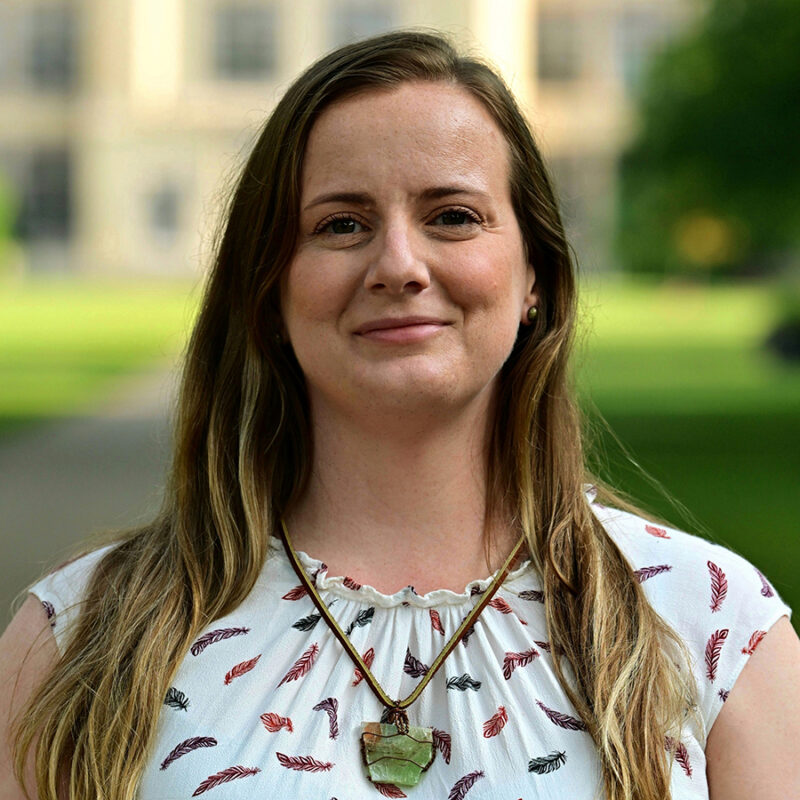
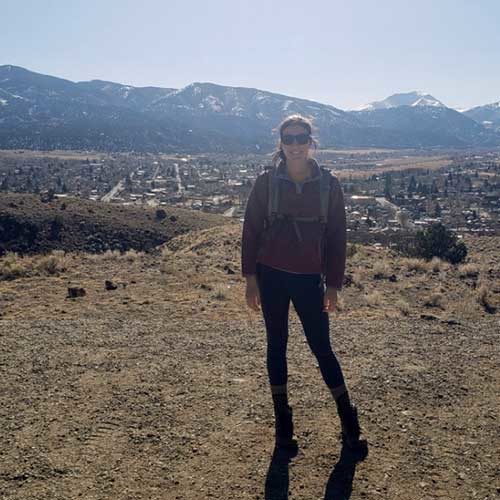
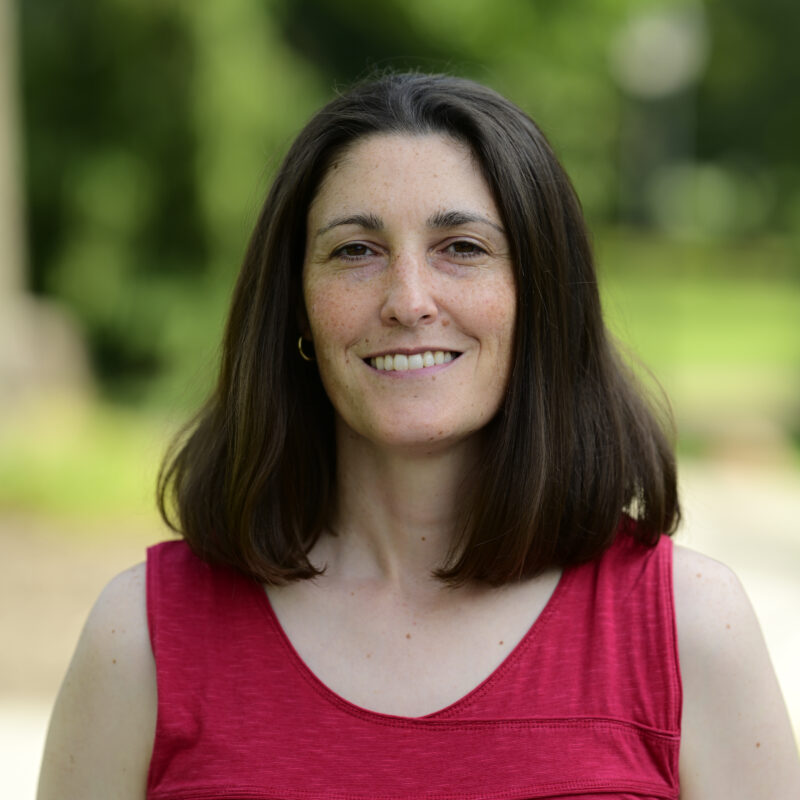
Eva Lyon ’07, visiting assistant professor of earth sciences at The College of Wooster

Eva Lyon

Visiting Assistant Professor of Earth Sciences

evlyon@wooster.edu

gray silhouette outline of a person

Natalie McCoy

Administrative Coordinator - Earth Sciences, Philosophy, Environmental Geosciences, Geology

nmccoy@wooster.edu

Meagen Pollock head shot

Meagen Pollock

Lewis M. and Marian Senter Nixon Professorship in the Natural Sciences; Department Chair of Earth Sciences

mpollock@wooster.edu

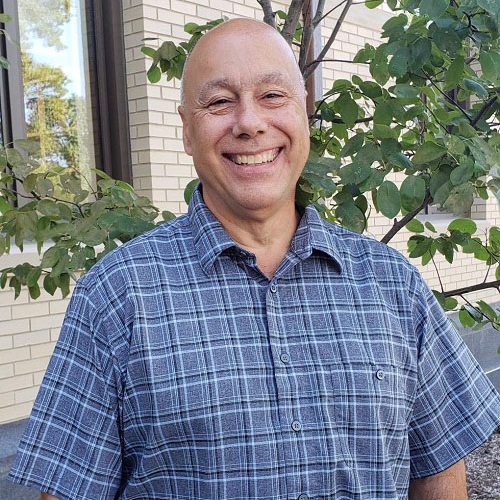
Timothy Siegenthaler

Timothy Siegenthaler

Instrument and Lab Tech/Machinist - Biology, Chemistry, Earth Sciences, Physics

tsiegenthaler@wooster.edu

Stephanie Sparks

Stephanie Sparks

Visiting Assistant Professor of Structural Geology & Tectonics

ssparks@wooster.edu

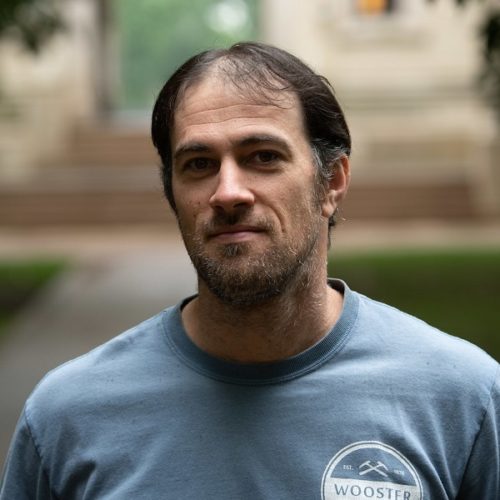
Nick Wiesenberg

Nick Wiesenberg

Geology Technician - Earth Sciences

nwiesenberg@wooster.edu

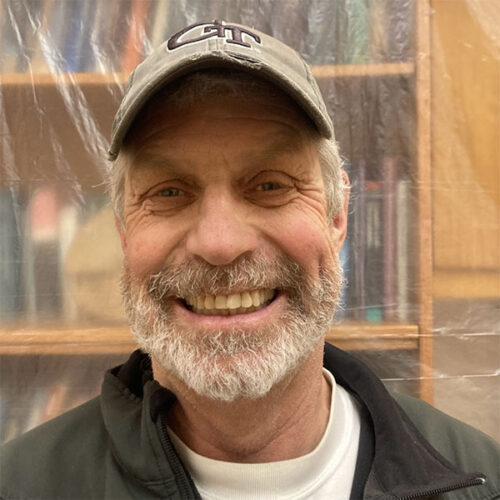
Greg Wiles head shot

Gregory Wiles

Shoolroy Chair of Natural Resources; Professor of Earth Sciences

gwiles@wooster.edu

Latest News

Stephanie Sparks, visiting assistant professor of geology at The College of Wooster

Geology professor uses her undergraduate training as an engineer to bring new insights to field

Stephanie Sparks, visiting assistant professor of geology at The College of Wooster recently published a paper that outlines a method for applying sensitivity analysis […]

Tyrell Cooper ’25 collects a tree-ring sample in spring 2022.

Wooster earth sciences team coauthors climate research on tree rings published in scholarly journal

Earth Sciences faculty, staff, and students at The College of Wooster recently published “Changing climate response of Northeast Ohio white oaks, USA: Is it […]

Eva Lyon ’07, visiting assistant professor of earth sciences at The College of Wooster

Wooster professor publishes article contributing to climate change research

Eva Lyon ’07, visiting assistant professor of earth sciences at The College of Wooster, recently published an article that is an important contribution to […]

Cady Eakins '25 in her APEX Fellowship at Akron Cooperative Farms

APEX Fellowship gives environmental studies major hands-on urban farming experience

When Cady Eakins ’25 went on a field trip to Akron Cooperative Farms with a class, she never expected that she would also gain […]

Major

The Earth Sciences major starts with a solid foundation in systems thinking and hands-on exploration, then offers flexibility to pursue specialized interests through two distinct tracks in Geology and Environmental Geoscience. In Geology core courses, students learn to work with incomplete datasets as they study the complex history of the planet and its continuing evolution, while Environmental Geoscience core courses focus on working with large, multidisciplinary datasets to study our interactions with Earth’s systems. Students then create the rest of their major by choosing advanced focus courses align with their intellectual interests and career goals. The tracks have sufficient overlap so that students can start taking classes without immediately choosing between them.

ESCI Major Requirements 2025 (pdf)

Minor

Completion of ESCI 101 Earth Systems and Global Change and the associated lab is required.

View Courses

Independent Study

The path to intellectual independence is rooted in the art of free thinking – something Earth Science majors at Wooster experience at the culmination of their degree through Independent Study (I.S.). During their junior year, students embark on a personal passion project with peers and faculty mentors, building the skills and curiosity needed for the senior I.S. – a signature mentored research experience where students shape and pursue their own questions, contributing new knowledge to geosciences and discovering their own potential. Along the way, students deepen their connection to each other and the discipline through authentic research experiences, like conducting fieldwork among the volcanoes of Iceland or glaciers of Alaska or working alongside professionals at research institutions like UNC Chapel Hill and the American Museum of Natural History. Over three semesters, each student designs a plan of study, completes the I.S. thesis, and presents and defends their work.

Search the I.S. Database

Student Year I.S. Title Major 1 Major 2 Advisor
Please search to view results
Athena Tharenos ’24

Triple major studies differing resources and utilizes multiple research styles

When Athena Tharenos ’24 first arrived at The College of Wooster, she didn’t consider herself much of an academic, nor did she see a […]

Corey Knauf '24

Environmental geoscience major combines two passions for senior research

Virginia native Corey Knauf ’24 has played the game of baseball for nearly his entire life. Just like a pitcher comes set for each […]

Nathan Kreuter

The Soybean–Soybean Aphid Interaction: Mounting Defenses and Overcoming Resistance

Name: Nathan Kreuter Major: Biology Minor: Earth Sciences Advisors: Dr. Andy Michel, Dr. Hilary Edgington The current rise of the global human population necessitates […]

Claire Wineman ’21

Scientific collaboration offers insights to farmers on soil health

Attracted to the idea of mentored research and “the opportunity to delve deeply into a topic and become an expert,” Claire Wineman ’21 came […]

Alumni

Graduates from Wooster with Earth Sciences training go on to jobs specializing in natural hazards, non-renewable and renewable energy, and water resources. They work for natural resource companies, consulting firms, and government agencies with job titles ranging from project manager and lab director to engineer and data analyst. Some go on to careers in science education in schools, national parks, museums, and non-profit organizations. Others pursue careers in communication as journalists, illustrators, and editors for media outlets, such as National Geographic. Many of our graduates make their way to top-tier graduate or professional programs to build careers in research, law, and more.

Sarah McGrath '17 conducting research off the coast of Chile in summer 2019

Geology alumna ­­awarded fellowship for climate research

The research opportunities at Wooster prepared Sarah McGrath ’17 for her graduate studies

Kelli Baxstrom ’16

Geology alumna researches landslides after natural disasters

As a geologist for the United States Geological Survey, Kelli Baxstrom ’16 put much of the expertise learned from her time at The College […]

John Talbot ’81

Involvement in student organizations prepares alumnus for leadership role

CEO of California’s Milk Advisory Board, John Talbot ’81, supports dairy farmers through challenges of pandemic

Lecture

The Richard G. Osgood, Jr., Memorial Lectureship in Geology

The Richard G. Osgood, Jr., Memorial Lectureship in Geology was endowed in 1981 by his three sons in memory of their father. Dr. Osgood was a paleontologist with an international reputation who taught at Wooster from 1967 until 1981. Funds from this endowment are used to bring a well-known scientist interested in paleontology and/or stratigraphy to the campus each year to lecture and meet with students.

2025 – Jill Pelto, Climate Artist and Science Communicator
2024 – Lisa D. White, University of California Museum of Paleontology
2023 – Terry Wilson, The Ohio State University
2022 – Andrew R.C. Milner, Paleontologist & Curator at the St. George Dinosaur Discovery Site
2020 – James White, College of Arts and Sciences at the University of Colorado Boulder
2019 – Alycia L. Stigall, Department of Geological Sciences, OHIO Center for Ecology and Evolutionary Studies, Ohio University
2018 – Maureen Raymo, Bruce C. Heezen Lamont Research Professor, Lamont-Doherty Core Repository Director, Lamont-Doherty Earth Observatory, Columbia University
2017 – Rob Thieler, U.S. Geological Survey, Coastal and Marine Geology Program, Woods Hole, Massachusetts
2016 – Patrick O’Connor, Ohio University Heritage College of Osteopathic Medicine
2015 – Scott White, University of South Carolina,
2014 – Jessica Conroy (’03), University of Illinois Urbana-Champaign
2013 – Michael E. Mann, Penn State University
2012 – George Davis (’64), The University of Arizona
2011 – Dr. Susan Lozier, Duke University
2010 – Dr. James W. Hagadorn, Amherst College

Labs Facilities

The Department of Earth Sciences is housed in Scovel Hall, one of Wooster’s most attractive buildings. Equipment available to earth sciences majors includes binocular and petrographic microscopes, a video system attached to a microscope, computers, photomicroscopes, zoom transfer stereoscope, fluid inclusion system, variable magnification scanning stereoscope, diamond saws and and rock grinding equipment, photography labs, thin-section machine, mapping projector, seismic station, and large sedimentological, paleontological and mineralogical collections. The earth sciences library holdings are unusually complete for a small college.

Paleontology

The paleontological facilities at Wooster include standard rock saws and grinders, along with Nikon microscopes, digitial imaging systems, and fossil preparation tools. We also have extensive research collections, particularly for carbonate hardgrounds, ancient bioerosion, Ordovician invertebrates, and Jurassic limestones and fossils.

Sedimentology

Ohio is a wonderful place to pursue undergraduate research in sedimentology and stratigraphy through Wooster’s Independent Study program. The local rocks provide an excellent sample of Paleozoic paleoenvironments and rock types. Our equipment includes GPS devices, computers, digital imaging equipment, numerous Nikon petrographic and dissecting microscopes, and the standard rock preparation tools, such as saws, grinders, and thin-section machines.

Wooster Tree Ring Lab

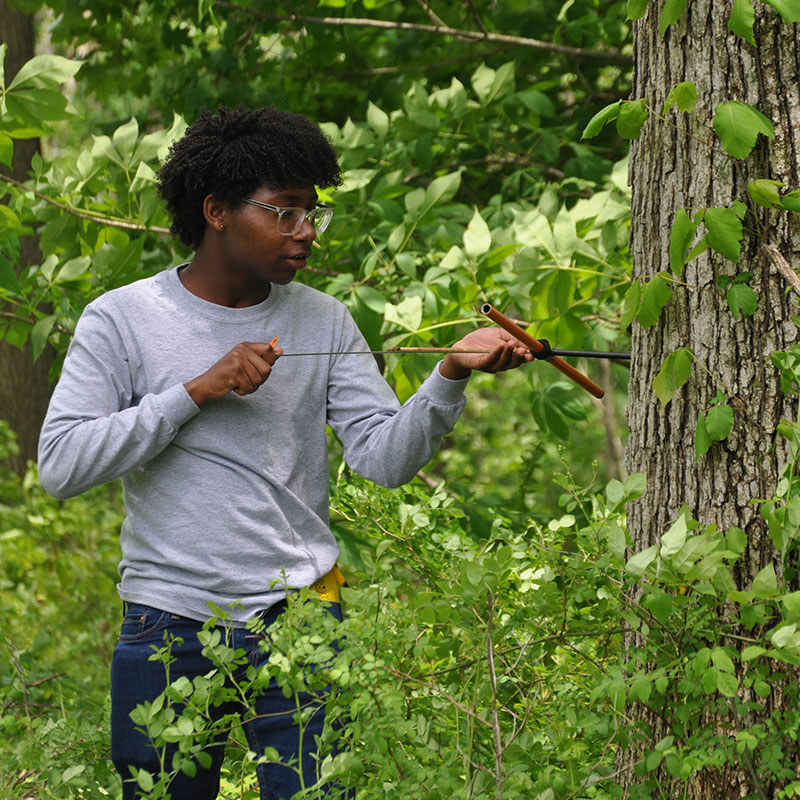
Dendrochronology, also known as tree-ring dating, is the method of scientific dating based on the analysis of tree-ring growth patterns. The tree-rings extracted from old wood can be calendar-dated and thus we can determine the calendar date the tree was cut. The tree-ring series are also records of past drought. We are interested in sampling historical structures for their tree-ring records. Our goal is to assemble long tree-ring chronologies from oaks by sampling both living trees and old wood. The data will be used by us and others in modeling past droughts in Ohio and together with similar records across North America.

X-Ray Lab

The acquisition of an X-ray Fluorescence Spectrometer (XRF) and an X-ray Diffractometer (XRD) was funded by the National Science Foundation to support Wooster’s robust undergraduate research program. In addition to providing our students with valuable hands-on analytical experience, we hope that the instruments will foster creative collaborations and interdisciplinary research. Please explore this site to learn more about the instruments, who we are, and the research possibilities.

Fern Valley Field Station

Fern Valley Field Station Annual Report

The Fern Valley Field Station is the College of Wooster’s outdoor facility to encourage scientific research, environmental education, and nature study. Graciously donated to the College by Betty and David Wilkin in 2012, Fern Valley is a 56 acre tract of wooded land in northern Holmes Co., Ohio and has already hosted visits from hundreds of students, faculty and researchers. Classes from the Biology and Earth Sciences Departments at the College frequently visit the site for field experience.

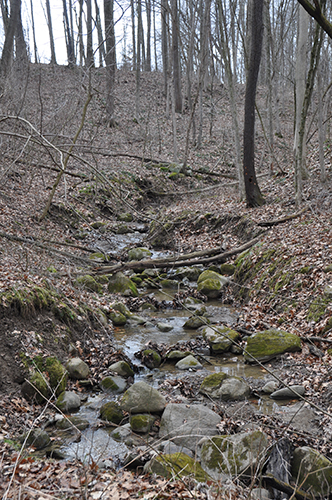
The property is located in a primarily agricultural landscape and one with many Amish neighbors. One of the primary features of the property is a second-order stream and several smaller streams that feed into it. The hilltops, valleys and ravines associated with these streams provide much of the topography associated with the property.

The forest is older second growth with an unusually high number of Ohio Buckeyes (Aesculus glabra). Other common trees include: Black Cherry (Prunus serotina), American Beech (Fagus grandifolia) and Sycamore (Platanus occidentalis).

Ongoing long-term research from faculty in the Biology and Earth Sciences Departments at the College of Wooster include general biodiversity surveys, studies of salamander ecology, invasive plant impacts, and the effects of deer browsing.

View a research poster on the Geologic History and Hydrology of Fern Valley

Facilities and Resources

The short access road leads to a small parking area. Nearby is a small cabin (constructed in 2015) that can be used for research or educational purposes. Basic field equipment and facilities for collecting and processing samples are available on site. Long-term data on climate at the Station and water flow in the streams are regularly collected. A list of known woody plants and vertebrate species from Fern Valley is also regularly updated. A number of established and marked trails are available (with more under development).

Contact

Parties interested in visiting or conducting scientific research at the Fern Valley Field Station should contact the Director, Dr. Rick Lehtinen.

Faculty Emeriti

Mark Wilson

Mark Wilson

Lewis M. and Marian Senter Nixon Professor of Natural Sciences

mwilson@wooster.edu